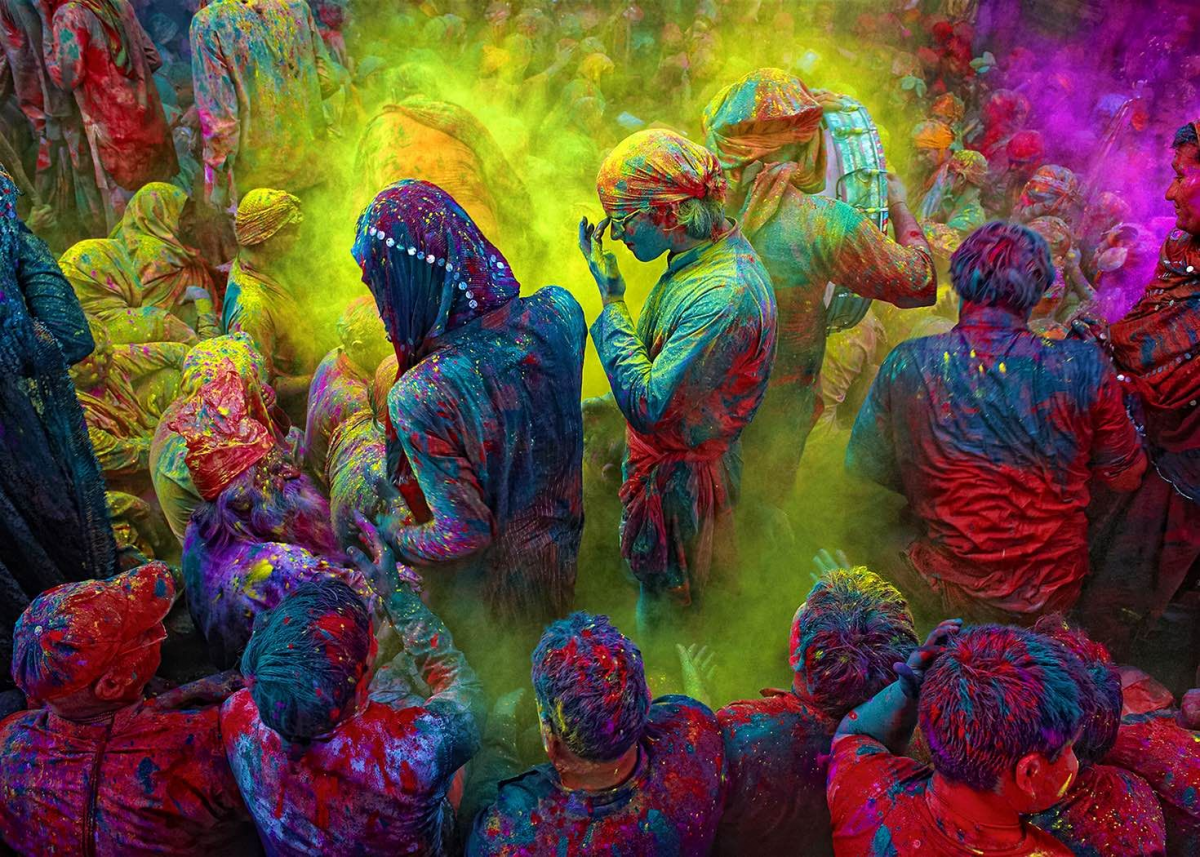
This year, the festival of Holi, which commemorates the triumph of good over evil, falls on the same day as Women’s Day, a celebration of gender equality and the recognition of women’s rights. Both the events coincide and celebrate the suppression of negativity and the overpowering of positivity in the world.
Holi: the victory of good over evil-

Indian mythology gives rise to the Holi festival, which commemorates Lord Vishnu’s victory over the demoniac Holika. All the negativity and evil in the world are burned away with the burning of Holika in the pyre. Every year, Holika Dahan is celebrated before the beginning of the Holi festivities throughout India. The celebration is frequently linked to the myth of Hiranyakashipu, a demon king who lived in ancient India. To murder his son Prahlada, a devout worshiper of Vishnu, Hiranyakashipu asked his sister Holika for assistance. Holika, using a cloak to shield her from the fire, sat on a pyre with Prahlada and tried to burn him. Holika burnt as a result of Prahlada being shielded by the cloak. During that evening, Vishnu was successful in eliminating Hiranyakashipu, and the incident was celebrated as the victory of good over evil. The night before Holi, a sizable bonfire is lit to commemorate this event in several locations around India.
International Women’s Day: empowering women

Women’s Day, which is celebrated to upscale women’s equality and the acknowledgement of their rights, can be viewed as a day to get rid of all the discrimination against women that permeates our culture. On International Women’s Day, we take a moment to reflect on women’s accomplishments, call for change, and celebrate the courage and persistence of ordinary women who have made significant contributions to their societies. Notwithstanding the remarkable progress made in the world, gender equality has not been achieved in any country. International Women’s Day (IWD) is a global festival that celebrates the social, economic, cultural, and political achievements of women. The day is a reminder to advance gender parity as soon as possible. There is a lot of activity as people around the world gather to honor women and their accomplishments.
Holika’s gender was altered for the better and used as a triumphant symbol. Similarly, both events this year can be commemorated jointly in order to destroy all of the negative stereotypes about women that persist in our patriarchal culture. The negative aspects which are present in our society for women should be eliminated and their individuality should be recognised.
Women who are the guiding lights of the world deserve to be respected and have the same status in the society as men but their growth is hindered because of some anti-social elements in the society. With the increase in the number of rapes, domestic violence or trafficking of women, the matriarchal culture keeps on decreasing.
This year can be used as an initiative to burn away all such things in the same pyre where Holika was burnt who symbolized a negative stature.

The festival, which is meant to honor good deeds in the world, ends up being “not so safe” for women who attend the festivities. Under the name of “Bura na mano Holi hai,” many women who participate in the Holi holiday find themselves on the receiving end of unwanted touch. Everybody has the right to happiness and safety during the holiday of Holi. Given the level of inhibition every woman experiences about being touched improperly, participation of women in the Holi festivities has decreased over time.
The Holi festival is primarily about having pleasure for many people. But it isn’t always free of harassment-related anxiety for women in India. Many women fear about venturing out in the throng and merely taking in the festival of colour in an unrestrained manner because to horror stories of groping, catcalling, and other sorts of harassment.
The guises of decorum and decency can be discarded by men during Holi. A gloomy truth hides underneath the vibrant colors of Holi. It’s a fact that men, at their most fundamental and primordial level, feel entitled to public areas and women’s bodies.
Throughout the formative years, Holi was a celebration of color, water fights, and “consensual” play. It was attended by families and friends. It was just the heteronormative family—the fundamental cornerstone of a patriarchal society—that was responsible for the sense of security one felt on Holi. But it was just at home a woman felt safe because when she is projected to a world outside the four walls of her house she is also prone to the evils and the dangers that exist there.

Since its inception, Holi has been associated with extroverts and those who prefer boisterous celebrations. Hence, it is not strange that women, who are raised to be introverts, are afraid of Holi.
On this particular day of the year, sexual assault is accepted and encouraged. After all, “Bura na mano, Holi hai” erases the issue of permission.
Thus, let this Holi festival, together with Women’s Day, serve as a way to burn away all these injustices against women. Let everyone participate and promise to treat women with respect.
Again considering Women’s day, in the lovely feminine dynamics they share, women are enjoying Holi together and feeling protected and seen. In many parts of India and in various states, women come together and celebrate Holi, also giving recognition to each other and empowering each other.
Some of the examples worldwide are-
Women gathered to celebrate Faag Utsav, or phoolon ki Holi, in the little Bhopal town of Binaganj. Prayers, singing bhajans, dancing, playing Holi with flower petals, and enjoying various delicacies were all part of the event, which was totally organised by women. These women gathered in order to celebrate with pure joy, leaving all problems behind.

Women use salvaged materials to create gulal and incense sticks. A group of 25 women in the state of Jharkhand are advocating sustainable living while also empowering themselves financially. The effort, which uses funds from the District Mineral Foundation, is a part of Project Matangi. The Rajrappa temple’s offerings are dumped into the river, which contributes significantly to pollution. Belpatra and flowers are both harvested, dried, and used to make incense sticks and organic colours, respectively.
Also see:
35 Indian Bridal Hair Accessories To Glam Up Your Bridal Look